Friday, January 17, 2014

The Summer of '72

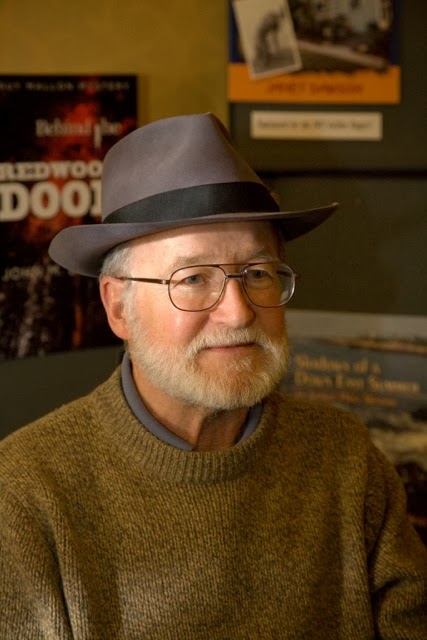
It is an honor and a pleasure to be a guest poster on J.R. Lindermuth’s blog. John Lindermuth is an author I admire, and I happen to know he enjoys doing research into the past to give added interest and information to his historical novels. I’ve never really considered myself a historical novelist, but I do enjoy the research involved in telling a story. Parts of my stories come from memory, parts from imagination, and parts come from research. This has been especially true of my newest book. Since that story takes place forty years ago, it almost qualifies as a historical novel. And what a wild time that was, even in a sedate, middle-class college town.…

Hooperman: A Bookstore Mystery, is set in and near Maxwell’s Books, a fictitious store in Palo Alto, Cal., during the summer of 1972. Palo Alto, back then, was not the epicenter of technology and business that it is today. It was still an upper-middle-class college town, although it was becoming more and more stirred up with important and divisive issues of the times.

Return with me now to those daring days of yesteryear.

A lot is going on during the summer of 1972: Jane Fonda is touring North Vietnam, George Carlin gets arrested for obscenity, and Bobby Fischer battles with Boris Spassky over the chessboard in Iceland. Nixon is still president, although this is the summer of the Watergate break-in, which will spell the end of Nixon’s presidency.

This is a time of big social and political causes. The war in Vietnam is still raging, as is the anti-war protest, along with other movements, such as black power, gay pride, women’s liberation, and the human potential movement, not to mention the sexual revolution. Maxwell’s Books, the locale of most of Hooperman, feels like the meeting place for all these movements. It is a bookstore owned by a celebrity pacifist, staffed by artists, musicians, dopers, dreamers, and poets.

Some of that summer’s best-sellers are: Jonathan Livingston Seagull, The Joy of Sex, Be Here Now, The Pentagon Papers, Open Marriage, and Another Roadside Attraction. Customers who frequent Maxwell’s Books include Joan Baez, Ken Kesey, Stephen Stills, Jerry Garcia, and Wallace Stegner.

I invite you to climb aboard the time machine known as a historical novel, in this case Hooperman: A Bookstore Mystery, and go back in time to the summer of 1972. I guarantee you a good ride!

Meanwhile, you might enjoy meeting a couple of the older members of the Maxwell’s staff:

Hooperman worked at the store almost a week before he caught another shoplifter, a teenager who had stuffed a Zap Comix under his Steely Dan concert tee shirt. The comic book was priced at half a dollar, so Hoop earned an extra twenty-five cents that day. Elmer was good about paying him his five dollars a day, and Hoop was still having a good time, so he decided to continue working at Maxwell’s Books as long as he could afford it.
It was easy work, although it was boring as dust except when he played like a customer and actually got interested in the books he was guarding. Hoop made friends with more of the staff, including a couple of Elmer’s old conscientious objector cronies from WWII, Pete Blanchard and Jack Davis, who squabbled over the right to take care of the Political Science section. Pete was a socialist, Jack was an anarchist, and their arguments stopped traffic all over the store. Neither one of them wanted anything to do with the section that Charley David had named The Times They Are A-Changin’. Kids’ stuff, they called it. Kids don’t know beans, they said. Charley was a painter whose jeans looked like a used palette.
“Kids these days,” Pete muttered one day when he and Jack were elbowing each other in the Politics aisle. Hooperman stood by, supposedly doing his job, mainly eavesdropping. Pete wore a jacket and tie to work and looked like a rumpled professor.
“Aaaah, give it a rest,” Jack countered. “You political dinosaur.” He hitched up his overalls and lit a Lucky Strike.
“No smoking in the store.”
“Says who?”
“Can’t you see this place is a tinderbox, Jack? You want to burn the store down?”
Jack turned to Hoop, raised his eyebrows, wiggled his cigarette, and said, “Now there’s an idea.”

Book synopsis

Hooperman: A Bookstore Mystery celebrates the joy of books and bookselling and also explores the many ways people get into trouble—deadly serious trouble—when they fail to communicate.

Hooperman Johnson is a tall, bushy-bearded man of few words. He works as a bookstore cop, catching shoplifters in the act. It’s a difficult job for a man with a severe stammer, but somebody’s got to do it, because Maxwell’s Books is getting ripped off big-time. And, more and more, it looks like the thief works for the store.

Set in the summer of 1972, the summer of the Watergate break-in, Hooperman is a bookstore mystery without a murder, but full of plot, full of oddball characters, full of laughs, and full of love, some of it poignant, some of it steamy.

“Pleasant and unusually good-natured, this novel from Daniel harkens back to a time when printed books mattered and an independent bookstore could be a social club for passionately eccentric bibliophiles.” —Publishers Weekly, starred review

Buy or order Hooperman: A Bookstore Mystery from your local bookstore, from Amazon, or direct from the publisher:
Oak Tree Press
1820 W. Lacey Blvd. #220
Hanford, CA 93230
217-825-4489
Publisher@oaktreebooks.com

For more info about Hooperman: A Bookstore Mystery:
www.danielpublishing.com/jmd/hooperman.html

•••
Author bio

John M. Daniel is a lifelong bibliophile, having worked in eight bookstores. He’s also the author of fourteen published books, including the well-reviewed Guy Mallon Mystery Series. He lives among the redwoods in Humboldt County, California, with Susan Daniel, his wife and partner. They publish mystery fiction under the imprint Perseverance Press (Daniel & Daniel).

john@johnmdaniel.com
www.johnmdaniel.com


Tuesday, November 12, 2013

Do You Ken Me Now?

May I have your attention.

Seriously. Getting and keeping another person’s attention is becoming increasingly more difficult.

Statistics show average attention span today is only eight seconds, a decline from 12 seconds in 2000. Eight seconds for a human is actually less than the attention span of a goldfish (nine seconds).

Of course, a goldfish has much less to engage its attention than a human. Still…

Some authorities are more generous with the figures, contending average attention span has dropped from 12 minutes to five. Minutes, not seconds. In either case, it’s not much as time goes.

Scientists have pointed the finger of blame at television and other technological distractions of our age. Look around you and note the focus of your peers on their smart phones and other devices providing a pathway to the Internet and all its distractions—aural, visual and tactile. Few of us are oblivious to these wonderful yet detrimental aspects of our society.

Fewer people are reading today and reading scores are on a steady decline. We’ve all heard too many of those who do read complaining of books being too long, too complicated or lacking in enough action. Where’s the challenge if everything is easy?

Some may want to pooh-pooh the idea, citing the awesome benefits offered by this access to so much information. The problem is, how much can an ordinary person digest without sacrificing concentration and the ability to absorb knowledge?

Our ancestors didn’t have the distractions of constantly ringing phones, blaring radios, TVs with streaming “news” everywhere you go, not to mention alarm clocks that wake one up with music, appliances and power tools adding to the din, and motor vehicles of all types rocketing around the neighborhood.

I’m not being a Luddite and advocating throwing out the baby with the bathwater. But wouldn’t it be nice every once in a while to shut off the technology and look—really look—at the person next to you and give him or her more than eight seconds of your time?

Seriously?


Sunday, October 20, 2013

Should You Know the History of the Place You’re Writing About?

(My guest today is Marilyn Meredith, prolific author of some 30 novels, including an award-winning series. Read on and you could have a character named for yourself in a future novel.)

Some might say, “No,” in my case since the setting for Spirit Shapes takes place in a fictional setting.

However, throughout the Deputy Tempe Crabtree series, I’ve woven in bits and pieces of the real history of the town it’s based on and I think that’s enriched each book.

In Kindred Spirits I wrote about the true history of the Tolowa people and the genocide that nearly wiped out the whole tribe and instigated by the then Governor of California.

I’ve written about the history of the Bear Creek Inn which once was a stage stop for people going higher into the mountains to see the big trees in several books. I wrote a lot about the history of the Tapper Lodge in Intervention even though that Lodge is fictional, but the history is borrowed from Camp Nelson.

Because at times I write about an imaginary Indian reservation but borrow a lot from the real one that I live near. I’ve often sprinkled wonderful facts of the history and legends from that reservation which have enriched various stories I’ve written.


In Spirit Shapes the haunted house is imaginary—but the old murders that happened in it are based on real murders—one that was highly publicized though changed in many ways for my mystery, and the other didn’t happen but was based on a story told me by someone long ago.

Finding out about the history of a place you’re writing about, even if you’ve fictionalized it, can give you material for you story that you might never have imagined.

As a reader, do you like to have interesting historical facts spicing up your fiction? And if you’re a writer, do you like to find out historical facts about the place you’re writing about?

Marilyn Meredith

Blurb for Spirit Shapes: Ghost hunters stumble upon a murdered teen in a haunted house. Deputy Tempe Crabtree's investigation pulls her into a whirlwind of restless spirits, good and evil, intertwined with the past and the present, and demons and angels at war.

Bio: Marilyn Meredith is the author of over thirty published novels, including the award winning Deputy Tempe Crabtree mystery series. She borrows a lot from where she lives in the Southern Sierra for the town of Bear Creek and the surrounding area, including the nearby Tule River Indian Reservation. She does like to remind everyone that she is writing fiction. Marilyn is a member of EPIC, three chapters of Sisters in Crime, Mystery Writers of America, and on the board of the Public Safety Writers of America. Visit her at http://fictionforyou.com and follow her blog at http://marilynmeredith.blogspot.com/

Contest:

The person who comments on the most blogs on this blog tour will have the opportunity to have a character named after him or her in the next Deputy Tempe Crabtree mystery.

Tomorrow I’ll be visiting here: http://thebookconnection.com.blogspot.com


Friday, October 11, 2013

About My New Book

History is story.

Story handed down orally, generation to generation. Story made more permanent in written form. Story as legend.

My latest book, “Digging Dusky Diamonds,” is this kind of history. Based on contemporary newspaper accounts, genealogical records, family stories and even some legends that have become part of the lore of Pennsylvania’s anthracite mining region where I grew up.

I clearly remember as a boy seeing throngs of miners pouring like a stream, their faces blackened, shoulders slumped in weariness, boots shuffling along the paving as they ended their shifts at the Glen Burn in Shamokin.

My paternal ancestors were mainly involved as canal boatmen and, later, as railroaders transporting the coal from place to place. But my great-grandfather, Henry Francis Fisher, his father and brothers were all miners. Three of Henry’s brothers died as the result of mine accidents.

My focus is on Northumberland and Schuylkill counties—the areas I’m most familiar with—though similar conditions prevailed across the anthracite mining region in the 19th and early 20th centuries.

While there is some technical information on the process of mining, the emphasis is more on the miners and how they and their families lived and worked, loved and died. The stories reveal the harshness of their lives, their daily concerns, their diversions, social attitudes and prejudices.

The accounts reveal what was different about those people and what has remained constant in us, their descendants.


Thursday, September 5, 2013

A Rose By Any Other...

Writers are fascinated by names.

There’s a whole science to the study of the origin and history of names. It’s called onomatology. As writers, we’re more interested in finding the right name than in delving into its origin.

As we create our characters—unless they whisper in our ears and tell us what they want to be called—we often struggle to find an appropriate name. I’m sure I’m not the only one who has changed a character’s name in midstream because the first simply did not click.

I’ve often wondered why Fran Striker, creator of the Lone Ranger, chose the name Tonto for the masked man’s companion, since the term means foolish in Spanish, Portuguese and Italian, surely an affront to the Native American community. Some sources indicate the name was proposed by James Jewell who contended it meant “wild one” in an unspecified indigenous language. Jewell also came up with Tonto’s trademark term, “kemosabe,” which he based on the name of an Upper Michigan summer camp. At least they did select Jay Silverheels, a genuine American Indian (Mohawk), for the radio and film roles.

Writers use a variety of means to select names. Some rely on the phonebook—just open to a page at random and take your pick. Others hold contests, offering readers the opportunity to have a character named for them. Not sure why anyone would want their name attached to a murderer—even a fictional one. I guess the quest for fame (or notoriety) takes us down some strange roads.

One thing we must strive to avoid is having characters with too similar names. This has a tendency to confuse readers. One way I’ve found useful to prevent this is to keep an alphabetical list of characters.

Names are important in my other life as a genealogist, too. I’ve found my work in that field a good resource for harvesting names. I keep a list of those which appeal for future use, forenames, surnames and even nicknames.


Frankly, I can’t think of a better source for a variety of common and unusual names.

Monday, August 12, 2013

Interview With Margaret Blake

My guest today is my friend Margaret Blake, a writer of page-turning contemporary and historical romances as well as thrillers. Welcome Margaret. Tell us about your latest novel.

MB: My latest novel “Under a Grecian Moon” is set on a Greek Island and in London. I have never been to Greece so it was exciting to do this. I chose the Greek setting because one day I was looking out of my window on a cold, dull November morning. I wanted to go somewhere warm. The novel is the story of past loves meeting after many years; there are secrets to be revealed and an adorable child. Although it is a contemporary romance there is an element of suspense, I think.

JRL: When and why did you start writing?

MB: I’ve always written for as long as I can remember. I never did anything about it until John (her late husband) persuaded me to take myself seriously. I think I wrote because I was an only child and often used to do this to amuse myself. My dad used to think it was smart of me and he was so proud when I had my first book published in 1978. I am so glad he was around to see that.

JRL: What do you see as the turning point in your career?

MB: I guess when I started taking myself seriously. John nagged me to do something about it and I researched publishers and then wrote a book I thought they might like. They didn’t like it but suggested if I had anything else I might send it in. This was a turning point. Always having loved Richard the Third I decided to write a novel and try in some way to exonerate his character. That book was accepted and it was the kick start for me to write more historical novels.

JRL: You’ve written in several genres. Would you give us your insight on the challenges in doing this.

MB: Well, you do the same, John; many writers do. It is challenging in that if you are writing historical you must do your research. I always try to remember that someone knows more than I do so I am very careful. Writing suspense is very challenging, I have changed things in these kinds of books. In one I fell right out of love with my hero. I think it worked but had it not done so, then I would have ditched the book.

JRL: Do you see switching from one genre to another as a good or dangerous thing for a writer to do?

MB: No, I see it as fun. Sometimes I feel I like to do something new and fresh. For me if I am just writing in the one genre I feel I might become stale.

JRL: Do you have a favorite genre?

MB: It’s all down to how I feel at that moment. For instance I loved writing “Under a Grecian Moon,” not only did it take me away from grey England in winter but it was fun, too. My last contemporary romance “Tilly’s Trials”I also enjoyed writing as it was looking at a young woman who had a serious problem with intimacy. Although it was a romance it looked at the challenges she had to face, it had humour, too, so I felt very light hearted at times. The funniest thing about this novel was when my grandson, then 14, saw the cover he asked. “Is it about bikes, Nana?” as there is a bicycle on the cover! Covers are very important!

JRL: What do you consider the biggest challenge in writing a novel?

MB: Since my husband died every novel has been a challenge. I would not say I have had writer’s block, but I have put off writing quite a lot. I really have to drag myself into my little study to work. Once I start work I am all right but it is getting there. I think this is because John always was the wind beneath my wing.  Generally, I didn’t have challenges, I just loved writing so much I got on with it. Really one challenge we all have is knowing when you have to ditch something you have been working on. Like parents with their children, they just don’t want to let them go when you know you have to.

JRL: Is there anything you’d like to say to your readers?

MB: It would be great if they would stop by my website and let me know what they think. It is quite new and I love it: www.margaretblake.com Also, if you want to be a writer, do it. I always used to tell people that it only costs the postage to mail a novel/story/article off to a publisher. Today it’s even cheaper than that with the Internet and e-book publishing. Don’t be shy. We all have to take that step into the unknown.

JRL: So, what’s next, Margaret?

MB: I have two books out next year. The first, in February, is an e-book version of a hardback novel I wrote a couple of years ago. Then, coming in April, is a new romantic suspense, “The Flower Girls,” which is set in Yorkshire and the South of France, both favorite places of mine. Thank you so much, John. It is always a pleasure to visit with you.

Readers can find details of all Margaret’s books at www.whiskeycreekpress.com and www.amazon.com


Wednesday, July 3, 2013

A Splendid Little War

This week we Americans will be celebrating the anniversary of the day the Continental Congress ratified the Declaration of Independence. Between picnics and fireworks many will also be remembering the terrible and costly battles that occurred over a three-day stretch in 1863 at Gettysburg.

A significant turn in another lesser known war took place between July 1 and 4 in 1898.

The Spanish-American War of 1898 is occurring as a background to my novel, Sooner Than Gold. Though the characters are not directly involved in the war it does affect their lives and intrude on their thoughts.

For this reason, I took a closer look than I ever had in the past at this conflict. It was another of those politically- and industrially-motivated wars which could have been avoided. The fact we entered it because of propaganda spouted by some with selfish and/or profit motivations does not diminish the bravery and patriotism of men (and women) willing to sacrifice all for their country. In all wars it is most often the bravest and most honorable who decline to speak later of their experiences.

What Teddy Roosevelt dubbed a “splendid little war” was promoted initially as a means of supporting the Cuban struggle for independence from Spain. Joseph Pulitzer and William Randolph Hearst drummed up public support for intervention. While their motives may have been sincere it didn’t hurt that the public clamor for information spurred newspaper sales as nothing had in the preceding months. It’s also worth noting the U.S. had important economic interests made uncertain by continued conflict between Spain and Cuba.

President William McKinley sought to broker a peaceful settlement. That effort was scuttled when an explosion rocked the USS Maine in Havana Harbor, killing 266 U.S. sailors. Though the exact cause of the explosion has never been determined, Spain was held to blame and the nation went to war.

On July 1, 1898 a combined American force of 15,000 infantry and cavalry troops launched an offensive that, along with a naval operation by the U.S. fleet, effectively doomed Spain’s hope of holding onto its colonies. There were setbacks, including a crippling outbreak of Yellow Fever, but the war was over by August 12, 1898.

A highlight of that July offensive was the taking of San Juan Hill by Roosevelt and his Rough Riders. Credit is due Teddy and his bully boys. What isn’t acknowledged often enough is that they might not have made the crest had they not had the support of all four of the U.S. Army’s “colored” regiments and a force of rebel Cubans.


As to the aftermath of the war, the U.S. Congress promised Cuba independence but added an amendment which prohibited the island from signing treaties with other nations or contracting a public debt. The amendment also provided for the establishment of a permanent American naval base in Cuba. You may have heard of it. It’s called Guantanamo. The U.S. also annexed the Spanish colonies of Puerto Rico, the Philippines and Guam. For the first time in history, the United States became an imperial power with colonies.