Monday, January 31, 2022

Popular Lawman Returns

 Syl is back!

Sheriff Sylvester Tilghman, that is. Syl is the third of his family to serve as sheriff of the small Pennsylvania town of Arahpot in the waning days of the 19th century.

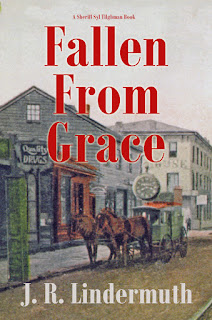
Syl first appeared in the cozy mysteries Fallen From Grace and Sooner Than Gold, published by Oak Tree Press. After the death of Billie Johnson, Oak Tree publisher, I regained the rights. I'm happy to say Lawrence Knorr, my publisher at Sunbury Press, agreed to reissue them under the Milford House imprint. Lawrence published The Bartered Body, third in the series, in 2018.

We'd hoped the books would have been out sooner, but the pandemic and other issues slowed the process.

Fallen From Grace and Sooner Than Gold are now available from Sunbury Press and soon will be offered from Amazon and other popular outlets as well.

As Fallen opens, Syl is a man focused on two problems--finding a new deputy and convincing Lydia, his true love, to accept his latest marriage proposal. The murder of a stranger in town suddenly makes his life more complicated.

In Sooner he confronts a murder victim with too many enemies, a band of gypsies hunting a man who stole one of their young women, a female horse thief, and other problems.

The books were popular with readers in their first inception and I believe, for those who haven't read them, lovers of cozy and historical mysteries will enjoy them. Oh, and I might mention, By Strangers Mourn'd, a fourth book in the series will be coming next.

For blurbs and more information, see https://www.sunburypress.com/collections/j-r-lindermuth


Tuesday, August 31, 2021

Finding Names for Characters

 One of the many things writers fret about is names.

A primary character needs a name that fits, one that's memorable and projects the right image. This is why the main character's name is often changed during the first draft. It isn't always easy to come up with a name that rings true to what we want to project about this particular character.

Beyond that, most every character in a story needs a name. It's how we're accustomed to identifying the people with whom we come in contact in our daily lives as well as in the books we read or films we watch. For minor characters, the issue is simple. Any bland selection of Christian and/or surnames might do.

Some writers hold contests in which friends, neighbors, and even strangers compete to have their names used in a story.

An easy source of names used to be the telephone book. In this digital age, those handy references are becoming scarce. Still, if you have access to one, pop it open to any random page, run your finger down a row and stop on a surname that strikes your fancy. Turn to another page and do the same in search of a first name that goes with the surname. Why not just use the Christian name of the surname you selected?


There's nothing to stop you from doing so. But suppose this and the devious deeds of your invented character offend the actual person whose name you've borrowed (who you don't know but who might chance to read your tale). You could be facing trouble in these litigious times.

Another useful source of names is television, especially game show contestants. There's an infinite variety available. Again, be wary of combining the name and behavior of those from whom you're borrowing. These people might chance to read your book, too.

A safer resource I've used a few times is to honor/dishonor an ancestor from the family tree by using their name. They aren't likely to sue.

One of my favorite sources of names is old newspapers. There's an infinite variety to select from and you can come up with some very memorable combinations. As I read these papers I make lists of any names that strike my fancy. I may never use all of them. But you never know when you might find just the right handle for a particular character.

In my latest novel, Twelve Days in the Territory, I used a combination of ancestral names, some selected from old newspapers and others that just popped up in my imagination. A few of the names I think will stick with readers are Crawford McKinney, Jubilation Kincaid, and Lazarus Lee.

Finding names isn't the most important part of writing a story. But it can be fun.

Thursday, August 5, 2021

SOME HISTORICAL BITS IN THE TRASH HAREM

 (I'm hosting my friend Marilyn Meredith today as she discusses her latest mystery. The floor is yours, Marilyn:)

Though this latest Deputy Tempe Crabtree mystery is set in modern times there are two bits of history that I incorporated into the plot.

The oldest was about the Pechanga Indians, who do play a minor part in this story. Like many of the native people of California, they had many struggles because of the Spanish missionaries during the 1700s. In the 1870s they were evicted from their homeland. Over the years, I’ve included much of the horrible things that happened to the California Indians in other Deputy Tempe Crabtree mysteries, most notably the Tolowa tribe of far northern


California which was nearly wiped out. But many other tribes were forced from their homeland to settle in reservations.

Like the Pechanga Indians, times have changed for many tribes because of casinos. The Pechanga casino, located in Temecula, is a popular place. Besides gambling and many restaurants, it has a venue for concerts and other events, and it even has a large campground.

Another historical thread in The Trash Harem revolves around the author, Erle Stanley Gardner. Gardner’s primary home was located on what had been the Pechanga’s land. The sprawling ranch had twenty-seven buildings including cabins for his four full-time secretaries. Even his doctor had a home there. When Gardner died, his estranged wife sold the ranch in 1970. In 2001 it was sold again, this time to the Pechanga Indians.

Because I was a huge fan of Erle Stanley Gardner’s books and an even bigger fan of the Perry Mason TV show, it was fun to revisit both as I wrote The Trash Harem.

Marilyn Meredith

Blurb:

Deputy Tempe Crabtree has retired from her job in Bear Creek when friends, who once lived in Bear Creek and attended Pastor Hutch’s church, ask her to visit them in Temecula. The husband, Jonathan, is a suspect in what might be a murder case. The retirement community includes many interesting characters, any of whom might have had a better motive than Jonathan. There is also a connection to Earle Stanley Gardner as well as the Pechanga Old Oak. What is a trash harem? You’ll have to read the book to find out.

To purchase The Trash Harem

https://www.amazon.com/Trash-Harem-Tempe-Crabtree-Mysteries-ebook/dp/B096KZDPH8/ref=sr_1_1?dchild=1&keywords=The+Trash+Harem+by+Marilyn+Meredith&qid=1622899167&s=books&sr=1-1

Marilyn Meredith’s Bio:

She is the author of over 40 published books including the Deputy Tempe Crabtree mystery series, and writing as F. M. Meredith, the Rocky Bluff P.D. series. She’s a member of two chapters of Sisters in Crime and the Public Safety Writers Association.

Webpage: http://fictionforyou.com/

Blog: https://marilynmeredith.blogspot.com

Facebook: https://www.facebook.com/marilyn.meredith


Thursday, May 6, 2021

Twelve Days in the Territory


Indian Territory in 1887 is the setting for Twelve Days in the Territory, my latest novel.

Outlaws take Martha Raker hostage and flee with her into the territory after a botched robbery. Martha is the niece of Isaac Gillette, the local sheriff, who is determined to track them down and bring her home. Martha is also the sweetheart of Will Burrows, a school teacher, and he is the only person willing to join the sheriff on his mission.

"Gillette wasn't thrilled to find the school teacher as the only person willing to accompany him on this dangerous enterprise. Still, it didn't entirely surprise him. Much as it irked him to admit it, Will Burrows had as much reason to pursue the killers as he did.

"But did the lad have the sand to see the job through? Gillette didn't know. Aside from observing the boy in Martha's company, he knew little about him. He'd never seen Will with a gun, nor did he recall ever hearing of him in a fistfight or even a shouting match with another person. Cole had personified the boy as a sissy in a few remarks, but then Cole and Will had been in competition for Martha's attention. And Cole had lost that battle; naturally he would be bitter and not apt to portray his rival in a good light."

Indian Territory was the government's dumping ground for the tens of thousands of Native Americans uprooted from their homelands coveted by settlers and greedy entrepreneurs. It didn't matter to officialdom that many of these people forced into juxtaposition with one another were mortal enemies. And, though the area was supposed to be a home for the tribes, by 1887 the territory had also become a refuge for outlaws and renegades. Cattle trails and railroads were crossing in response to eastern market demands and rich mineral, timber and land resources were drawing the attention which would soon lead to land rushes opening expanses of the territory to non-Indian settlers.

Indian Territory covered some 74,000 square miles. Gillette and Will have a big area to cover. Complicating their mission, Gillette has no jurisdiction in the territory; he's an intruder despite his badge. There were Indian courts and tribal police, but they had no authority over cases involving non-Indians. Normally, deputy marshals would have been dispatched from Fort Smith in pursuit of the outlaws holding Martha.

Gillette isn't inclined to wait for someone else to do the job, and neither is Will.

Martha is certain her uncle and Will are on their trail. Meanwhile, she's also doing something about her situation. She's leaving a trail for Will and her uncle to follow, she's paying close attention to the conversations of her captors, and she's taking advantages of opportunities for escape.

You can grab a copy of the book in print or electronic format here https://www.amazon.com/gp/product/B0929FBTKP/ref=dbs_a_def_rwt_hsch_vapi_taft_p1_i6


Sunday, May 17, 2020

Things Could Be Worse


We live in a time of adversity. Some might call it the worst of times. Yet, some have said the same of other times.
That's, coincidentally, true of the Spanish flu of 1918. My great-uncle and namesake was at Camp Funston in Kansas where some historians believe it originated. My relative was one of the fortunate who survived that pandemic which claimed an estimated 50 million lives around the globe.
The true extent of damage, both in lives and economics, for COVID-19 remains to be seen.
We are, though, more fortunate in many ways than our ancestors who suffered through the Spanish flu.
The Internet, for instance, provides the latest information and updates it in a timely fashion. The news didn't travel as fast in 1918. On the downside, conspiracy theories and quack prescriptions spread equally as fast as facts these days, adding to confusion and heightening fears.
Again, thanks to the Internet, China was able to dispense the DNA of the virus to other nations in a remarkably short time, giving researchers a leg up on understanding the virus and, hopefully, speeding up the process of developing a vaccine.
There's also the fact many advances have been made in medicine since 1918, advances which assure better treatment of patients and ability to save lives. In 1918, we didn't even know what a virus was, let alone how to deal with one. Physicians knew the disease spread through respiratory drops but they didn't have microscopes powerful enough to view a virus. You couldn't test for something you didn't know existed.
Because they did know how it spread, they did determine the value of social distancing, which has proven equally effective in the current pandemic. Unfortunately, then as now, some people are slow learners and fail to heed the best advice.
Then, as now, some in high offices put the economy or their own self-interest above the welfare of the public and downplayed the dangers, pushing to ease restrictions and social distancing. That did not bode well then, and it won't in the present. This is a dangerous disease and it won't go away just because we want it to.

Monday, January 6, 2020

FAVORITE READS OF 2019


I read 63 books in 2019, as always a mix of fiction and non-fiction.
Not all were published in the past year. When they came out isn't a criterion for selection. Like wine, some books improve with age. Here's my assessment of the 10 best in no particular order.
BEAR NO MALICE by Clarissa Harwood. Sometimes genre is a matter of interpretation. Some readers might view this first novel as a romance. It can just as easily be seen as a mystery or a historical novel.  What really matters is story. The reader is treated with insight into the politics of the Anglican church, the art world of the period and the stifling conformity of the Edwardian era--an intriguing mix of historical fiction, romance and mystery. Highly recommended.
NEW IBERIA BLUES by James Lee Burke. We've had a long wait for another Dave Robicheaux novel. Burke never disappoints. The violence in the novel may put off a more squeamish reader. But, trust me, the reward for overlooking that is some of the most lyrical prose and meditations on virtue you'll find in contemporary fiction. Intimations of the mortality of Dave and Clete signal this may be the final episode in the series. I sincerely hope not.
WHERE THE CRAWDADS SING by Delia Owens. This is a novel about survival and Kya, the protagonist, is adept at survival in the face of enormous odds. Abandoned by her mother, her siblings and, finally, her father, she is left alone to adapt and survive on North Carolina's Outer Banks in the period between the 1950s and 1970s. This is a debut novel by a scientist known for her nature writing. Her prose is poetic and beautiful and the insights into the workings of nature are informative and moving. The plot had me hooked from the start.
THE LOST MAN by Jane Harper. This is a page-turner with lots of surprises and a conclusion to shock even the most hardened crime reader. Jane Harper has crafted an enthralling tale of suspense, relationships, vivid characters and a landscape so real you can taste the dust and sense the lonely emptiness.
GERONIMO'S BONES by Darrell Bryant. The story may not be true, but it's truthful. Chaco, a young Apache man born in the wrong century, struggles against harsh odds to adapt to the life fate has given him. This is a novel with engaging and colorful characters, adventure, humor and tragedy. It isn't often a first novel resonates so well. I look forward to reading more of Darrel Bryant's work.
KILLERS OF THE FLOWER MOON by David Grann. This non-fiction book targets a series of murders in the 1920s in which oil-rich Osage Indians were victimized and robbed--another chapter in the genocide of the native peoples. I've long been a fan of Grann and here he excels as a storyteller and reveals a little known chapter in history.
UNSHELTERED by Barbara Kingsolver. Two families in two different time periods inhabit a house in a unique New Jersey community. Their lives are changed in dramatic ways. Kingsolver introduces a real life pioneer woman naturalist who deserves to be better known. The contemporary characters were interesting, but I was more drawn to those in the earlier historic period.
THE FURIOUS HOURS by Casey Cep. The book Harper Lee couldn't write and possible reasons why--in addition to fascination insights on a murder for profit scheme, an ambitious lawyer, the South and Southerners and sundry other topics of interest.
THE FEATHER THIEF by Kirk Wallace Johnson. This unusual but true story has all the elements of a thriller and takes the reader into a bizarre world of obsession and greed pitted against science and beauty.
LADY IN THE LAKE by Laura Lippman. This stunning standalone novel set in 1960s Baltimore, portrays Maddie, a bored housewife who decides on the spur of the moment to leave her husband and become a crime reporter. Lippman's inspiration was the story was too real life disappearances in that time period in the city. The result is a compelling story.


Tuesday, October 22, 2019

A Little Help From a Friend


(We all need a little help from time to time. I'm hosting my friend Marilyn (aka F.M.) Meredith, and she's talking about her new mystery and how friends help in the writing process. The floor is yours Marilyn:)

To be honest, I get a lot of help from friends when I’m writing a book, from my critique group who initially hear the whole story chapter by chapter, and my editor who is also a friend.

Because I write about law enforcement and crimes, and have no past experience of my own, I rely on my police contacts to help me out with a lot of elements in a story. In this particular book, I needed to learn about old skeletons, and also about cadaver dogs.

About both topics, I had help from Dr. Rao who is in my critique group, he shared a book by an expert in identifying buried bones.

Two members of Public Safety Writers of America, Gloria Casale and Ron Corbin gave me lots of information about how dead bodies might look under the circumstances in the story.

I put out a query about cadaver dogs on Facebook and heard from a friend who is a former police officer who put me in touch with a woman named Vynn Stuart who worked for a sheriff’s office for 20 years as a Special Deputy K-9 Handler. We emailed back and forth as she answered my many questions. Once I’d finished the section that I needed her help with, I sent it to her and she made some corrections.

A fun part of all this is she gave me the name for the character, part of her name, and wanted the description to be as she looks. Of course, I did exactly what she asked. She wants her grandkids to be able to recognize her in the book. I hope when she receives a copy of Bones in the Attic she’s not disappointed.

Marilyn aka F.M.

Blurb: The discovery of a skeleton, a welfare check on a senior citizen, and a wildfire challenge the Rocky Bluff P.D.


Bio: Marilyn Meredith, who writes the RBPD mystery series as F.M. Meredith, is the author of over 40 published books. She once lived in a small beach town much like Rocky Bluff and has many relatives and friends in law enforcement.

And she’s a regular on these blogs:
4th Monday of the month: https://ladiesofmystery.com/


Saturday, August 24, 2019

Read an Excerpt From The Bartered Body


Tuesday, February 7, 1899


Chapter 1.

            “She’s gone,” Virgil Follmer said.
            “What? Who?”
            Virgil’s head shot forward, his face going red as he rose up on the toes of his boots in an effort to appear taller than he actually is. “Dammit, Tilghman,” he bellowed, “open your ears. Don’t make me repeat myself. Time’s a-wastin’.”
            Virgil’s our town undertaker and generally the most docile, quiet man you’d ever want to meet. So, seeing him get this excited, I knew something terrible must have happened. “Calm down,” I told him. “I’m not a mind-reader. You’ll have to explain if you want my help. Now—who’s missing?’
            “Why Mrs. Arbuckle, of course. Somebody’s stole her body. Zimmerman’s gonna have a fit.”
            The late Mrs. Arbuckle was Nathan Zimmerman’s mother-in-law. Zimmerman is burgess of Arahpot, which makes him my boss. This news imposed a bit more urgency on my response. “I’ll get my hat and coat and be right with you,” I told Virgil.
            I’d just returned home and was heating up a pot of soup Doc Mariner’s wife had sent over when Follmer commenced pounding on my door.
            He waited impatiently by the door while I took the pot off the stove and got my garments. “If you’d subscribe for phone service a body wouldn’t have to go runnin’ half way across town to fetch you,” Virgil snarled.
            I’m the third of my family to hold the job of sheriff here in Arahpot, Jordan County, Pennsylvania, and I take my responsibilities seriously. But I have enough people yammering at me during the day at the office and prefer not to make it so convenient for them once I’m home for the evening. Of course I didn’t explain this to Virgil. Instead, as we strode down the hill toward town, I asked, “Didn’t you stop at the office? Cyrus should be there.”
            Virgil huffed. “If I’d wanted your deputy, I’da gone there. Thought this was important enough for your attention.”
            I couldn’t dispute his remark.
            Slush from the last snow made walking precarious and we had to concentrate on where we stepped to avoid slipping. It didn’t prevent Virgil from continuing to harp on the subject of the telephone.
            “I’m sure Miss Longlow would have seized the opportunity for the telephone contract if she’d known about it in time,” he said.
            I couldn’t argue the point. Lydia is one of the most astute business women I know and she certainly would have added the telephone to her various enterprises if McLean Ruppenthal hadn’t got the jump on her with prior knowledge—one of the benefits of being on the borough council, I suppose. He got the telephone franchise and has his sister Cora operating the switchboard. That makes him privy to many of the secrets in town—another advantage I’m certain he hasn’t overlooked.
            Still, this wasn’t the subject on my mind at the moment. “Never mind all that for now,” I said. “Why don’t you fill me in on what happened before we get to your place and I have to face Zimmerman.”
            Virgil gave me a look like a startled deer. “God, I haven’t told him yet. I wanted to talk to you first.”
            “Well, you haven’t told me a thing so far—other than that the old lady’s body is missing. How’d it happen?” I drew my collar closer round my neck against the damp chill of the evening, wishing I’d have thought to bring the nice warm scarf Lydia has knit for me.
            Follmer heaved a sigh and skipped his short legs in an effort to catch up to my longer pace. “I wish to heaven I knew how it happened. We had her all laid out nice in the coffin, set to deliver her for the viewing. Before goin’ out for supper I stepped in to make sure all was in readiness. The casket was empty. Syl, I know that old lady didn’t get up and walk out of my place on her own.”
            “That don’t make a bit of sense, Virgil. Why would someone steal a body?”
            “I don’t know. But they sure as heck did.”
            ‘I take it Floyd helped with the layin’ out,” I said, referring to Virgil’s assistant.
            “Course he did.”
            “Maybe he moved the body and you looked in the wrong coffin.”
            He peered at me as though my remark was the most idiotic he’d ever heard. “Why would he do that? I know which casket I put her in.”
            I shrugged. “Just a thought.”
           
(Want more? The Bartered Body is available from https://www.sunburypressstore.com/The-Bartered-Body-9781620067567.htm, or https://www.amazon.com/gp/product/B07C96SBBT/ref=dbs_a_def_rwt_hsch_vapi_tkin_p1_i9 and from many other booksellers)
Thursday, February 7, 2019

Excerpt From a Favorite Novel


All writers have favorites among their books. One of mine is Watch The Hour. It's a tale of conflict between miners and mine owners in the 1870s in Pennsylvania's anthracite coal region.
I'm offering here a short excerpt from the book. McHugh, Haley and Farrell, miners accused of ties to the Molly Maguires, have escaped from jail and jumped a train, hoping to elude pursuers:
The conductor approached and McHugh slunk deeper into the seat. He felt Haley stir beside him and Billy Farrell gave a little sigh.
"You're tickets, gents," the conductor said as he stood over them.
"We already gave 'em," Haley said.
"That's right," McHugh added. "We paid when we got on."
Up front, the engineer blasted on his whistle and the train swayed and rocked a bit as it rounded a curve somewhere along the line to Arahpot. McHugh felt the sweat beading on his forehead.  He'd told Haley it wouldn't work.
The conductor exhaled sharply as he stood braced on his big feet before them. "Gentlemen," he said, "I'm the conductor, and you have not paid me for your fare."
"Maybe it was the other one," Billy told him.
"There ain't no other one. There's just me, and you boys didn't pay me."
McHugh jumped up and seized the man by the collar. Billy stood up and took the man's arm on the other side. "Look," McHugh told him, "we don't want no trouble. We just need to catch a ride with you for a ways."
"Damned if I'll let you get away with that," the man shouted
That was when Haley grabbed the pistol out of McHugh's waistband and shoved it in the conductor's face. He snapped the trigger twice but the gun didn't go off. Frustrated, Haley smacked the man across the cheek with the revolver's barrel. The conductor's head bounced back, but he was a strong man and he struggled to free himself from McHugh and the boy.
A drummer across the aisle jumped up. When Haley turned and pointed the gun at him, the man ran out of the car, screaming for help.
"Oh, hell, we're in for it now, boys," Haley said.
The words were no sooner out of his mouth than two of the crew came into the car and strode toward them. Haley raised the gun and fired at them. This time it went off. Three times.
Bam! Bam! Bam!
The first shot passed through the coat of the brakeman. The second bullet narrowly missed the fireman and smashed a window behind him. The third tore off the man's earlobe and he stopped in his tracks, squealing with pain.
McHugh and Farrell released the conductor and made for the opposite end of the car, Freed, the conductor dove for Haley. Haley smashed him in the face with the butt of the revolver and the man fell in a heap at his feet.
"Come on, Humpty," McHugh yelled. "Let's get out of here." He and Billy went out the door and jumped off the train. Haley followed.
https://www.amazon.com/gp/product/B01E9D5648/ref=dbs_a_def_rwt_hsch_vapi_tkin_p1_i7

Tuesday, January 8, 2019

Fact And Fiction On The Flu

(My guest today is J. L. Greger, scientist/novelist, who shares some interesting information and an introduction to her latest book. The floor is yours, my friend:)


The flu epidemic of 1918-19 is the largest pandemic ever. One-third of the world population was infected and 20 to 50 million people died. Although it is sometimes called the Spanish Flu, it probably first developed in or near a military base in Kansas.

This epidemic inspired not only many scientists but also many authors of fiction.

First, the science. In 2005, scientists reconstructed this H1N1-type flu virus that caused the 1918 epidemic. They believe at least a portion of the human population has some residual immunity to this or similar viruses. That means the virus that caused the 1918 epidemic probably could not cause another epidemic. BUT new mutations of avian or swine flu viruses could create a new flu virus transmittable among humans. In that situation, humans might have no residual immunity to the virus and another pandemic could occur.

Now the fiction. Epidemics are the basis of many famous novels and movies. Consider: The Stand by S. King, The Plague by A. Camus, Arrowsmith by S. Lewis, World without End by K. Follett. Generally, the medical details are incorrect in these novels, and the epidemics resemble a mix of cholera, plague, and flu.

Authors have used the epidemics so frequently in fiction because epidemics are urgent situations which bring out the best and worst in their characters. Probably, the most interesting use of the 1918 flu epidemic was in Downton Abbey. It was a way to eliminate lady’s Mary’s rival for the attention of Matthew Crawley.

The most realistic view of an epidemic occurred in the 2011 movie Contagion. However, this movie didn’t allow viewers to develop much sympathy for victims. The Flu Is Coming realistically portrays what would happen if a new virulent flu virus struck but allows readers to have empathy not only with patients and medical personnel treating patients but also scientists and police trying to control the spread of the flu.

Prescription. Try it, ,you’ll like learning a bit of science on drug development while you’re frightened by the quarantine and what it unleashes among residents of a small community.

Blog: In The Flu Is Coming, a new type of flu — the Philippine flu — kills nearly half of the residents in an upscale, gated community in less than a week. A quarantine makes those who survive virtual prisoners in their homes. The Centers for Disease Control recruit Sara Almquist, a resident of the community, to apply her skills as an epidemiologist to find ways to limit the spread of the epidemic. As she pries into her neighbors’ lives, she finds promising scientific clues but unfortunately learns too much about several of them.

The paperback version of The Flu Is Coming is available at: https://www.amazon.com/Flu-Coming-Science-Traveler/dp/0578423251. The Kindle version at:
https://www.amazon.com/Flu-Coming-Science-Traveler-Book-ebook/dp/B07KX3J37W

Bio: J.L. Greger is a scientist and research administrator turned novelist. She likes to include tidbits of science in her award-winning thriller/mystery novels: Murder: A Way to Lose, Riddled with Clues, and others. To learn more, visit http://www.jlgreger.com


Saturday, December 29, 2018

Ten Recommended Reads


As is my custom, as the year winds down I like to assess the books I've read and make some recommendations.
Since I'm a voracious reader of both fiction and non-fiction (reads and re-reads nearing a hundred and the year isn't quite over), I'm limiting to just 10 books in the mystery genre this time around. Note, they weren't all published in 2017 either. Here they are, in no particular order:
A RECKONING IN THE BACK COUNTRY by Terry Shames. The vicious murder of a doctor from out of the area poses a perplexing mystery in this seventh in the Samuel Craddock series. I don't know why, but this was my first experience with this series. It won't be the last.
SEE ALSO PROOF by Larry D. Sweazy. This Marjorie Tremaine mystery takes the reader on a harrowing journey back to the 1960s--which weren't as wonderful as some would have you believe.
ROBICHEAUX by James Lee Burke. It's been far too long since the last visit with Dave and the gang. Burke has given us other novels in between, but Robicheaux remains my favorite of his creations.
THE LINE by Martin Limon. This page-turner with Army Criminal Investigation Division agents Sueno and Bascom takes the reader on a nail-biting jaunt to the DMZ where a South Korean soldier has been murdered and their investigation threatens to set off an international incident.
A KNIFE IN THE FOG by Bradley Harper. I'm not a fan of writers appropriating the character(s) of others for their own stories. But rather than "borrowing" Sherlock Holmes, Dr. Harper has employed Conan Doyle, his creator; Dr. Joseph Bell, Doyle's mentor, and Margaret Harkness, a remarkable woman, whom I'd never heard of before, for a brilliant and plausible joust with Jack the Ripper, whose bloody exploits continue to fascinate and remain as shrouded in mystery as the foggy streets of 19th century London.
THE WITCH ELM by Tana French. I've enjoyed her Dublin Murder Squad series but this stand-alone with an unreliable narrator may be my favorite of her works. Psychological suspense at its best.
FIVE DAYS, FIVE DEAD by Carole Crigger. I've been a fan of Crigger's China Bohannon since reading the first in the series. This fun romp in the Wild West is a good introduction if you haven't yet read any of the previous novels.
THE STRANGER HOUSE by Reginald Hill. This standalone by the late, lamented author of the superb Dalziel/Pascoe series isn't new (published in 2009) but it's erudite, witty and highly entertaining.
BODY AND SOUL by John Harvey. This is the final episode in Harvey's Frank Elder series and, based on his own comment, his last novel. As always, it's sharp and gripping. Personally, I hope there are more novels to be written by Harvey. If not, there are still a good many I haven't read.
SMOKE AND ASHES by Abir Mukherjee. This is the third outing for Captain Sam Wyndham and his sidekick Sergeant "Surrender-Not" Banerjee and I hope there are many more. Sam's addiction put his career in jeopardy as he tries to solve several ritualistic murders and Banerjee grapples with family and personal issues amidst the turmoil of Gandhi's Indian independence movement.

Tuesday, November 6, 2018

Writing Habits

(My guest today is Marilyn Meredith aka F. M. Meredith who is going to share with us some thoughts on writing and a bit about her latest mystery, Tangled Webs.)


It’s always interesting to learn how different writers write, if and how they schedule their writing time, where they like to write, music they like to listen to, what they drink while writing.

One of my favorite writers does the majority of his writing in a diner, others I know head to the local coffee shop, or the library. For me, having to go someplace to write would not work—plus, I know I’d be distracted in a public place. Watching people is too much fun.

Mainly I write at my desktop computer in my office in my home. No photo, it’s generally on the messy side. Because I have a big family, big and little people drop in unannounced. I have no problem at all getting back to work after they leave.

Some writers I know set aside a particular number of hours a day to write, much like working at a regular job. Others write at night after all is quiet. I prefer writing in the early morning hours while most in the house are still in bed—but I keep on going until I know I’m done for the day. However, there are times when the muse strikes me at odd hours and I’ll return to the computer.
And no, I don’t write every day—some days I’m busy with other business connected with writing, or just life.

I tried using music to set the mood for whatever I was writing, but gave it up. It was far too distracting. However, I always begin my day and the writing process with a cup of Chai latte.

One last little tidbit, I know some writers stay in their PJs all day. Not me, I get dressed first thing after I rise. Remember, I wrote that people drop in unannounced? I’ve had family arrive before 6 a.m. for one reason or another.

So, you other writers out there, what are your writing habits?

Marilyn
writes the Rocky Bluff PD series as F. M. Meredith

Blurb: Too many people are telling lies: The husband of the murder victim and his secretary, the victim’s boss and co-workers in the day care center, her stalker, and Detective Milligan’s daughter.


Bio: F. M. Meredith who is also known as Marilyn once lived in a beach town much like Rocky Bluff. She has many friends and relatives in law enforcement. She’s a member of MWA, 3 chapters of Sisters in Crime and serves on the PSWA Board.

Facebook: Marilyn Meredith
Twitter: @marilynmeredith

Tomorrow I’m heading to Thonie Hevron’s blog: https;//Thonie hevron.wordpress.com/ and letting everyone know what I’m thankful for as a writer.


Tuesday, October 9, 2018

Reader Survey, Part 2


Writers--unless they're like J. D. Salinger who in his latter days was only interested in the process--seek readers. Traditional wisdom says the best way to do that is to give readers what they want.
So, how do we discover what readers want?
In my opinion, the best way is to listen to what they say. One source of information is surveys such as one conducted by M. K. Tod, an author and blogger at https://awriterofhistory.com/ She's been conducting these surveys since 2012 and they provide a wealth of insight into the minds of readers from around the globe.
Last  week I commented on the 2018 survey findings on issues of interest to readers. Naturally much of that should have been of interest to writers, too. We learned 75 percent of the participants still prefer print books over electronic format. They told us they mostly read fiction for entertainment and their most popular genres are mystery/thrillers, romance and historical fiction.
Granted, this was not a huge survey. But more than half the 2,418 respondents said they read more than 30 books a year. That's a significant number.
This week I'm focusing on matters of more concern to writers, specifically how to give readers what they want.
One topic I found most interesting was how readers determine what to read next. The most important factor, they related, is subject matter and genre. The least important--the publisher or imprint. Though we've been told time and again covers are an extremely important factor in sales, that wasn't borne out in this survey. Cover was somewhat a factor (slightly more important to women than to men), but not an overriding concern for most. Identity of the author varied with age groups. Fifty-four percent for those over 70 but only 29 percent for those under 30.
We've also had the importance of reviews drummed into us constantly. Yet (and I wasn't totally surprised) reviews weren't the top factor in this survey. These readers (and I believe most) rely predominately on the recommendation of friends. That's not to say reviews aren't important. Favorite review sites were second in preference, closely followed by sites such as Goodreads and simply browsing in a bookstore. Except for Amazon, advertising/promotion seldom rose above 20 percent for the respondents.
Another factor writers should keep in mind, women read more than men. Sixty percent of the women responding to this survey said they read more than 30 books a year. You're free to write whatever you like. But, if your books don't appeal to women, you're missing a large part of the market. And, they love fiction. Eighty-eight percent of the women expressed a preference for fiction in their book reading.
Some of the factors women cited as important in their reading were authenticity, characters who are both heroic and human, a fast-paced plot, and feeling immersed in the novel's world.
Giveaways have long been a big marketing ploy. Yet only 30 percent of the respondents (male and female) found those of interest. They were more interested in reading a magazine or newspaper article about a book (60 percent), following an author on Facebook or Twitter, reading an author's blog or newsletter, or meeting an author in person.
As to how they purchase or acquire their books, 70 percent of the respondents said they buy on line. Libraries also remain a strong source, particularly for women.
For a more in depth look at the survey, use the link above to M. K. Tod's site.


Monday, October 1, 2018

A Survey of Readers


This summer I was one of more than 2,000 persons who again participated in a survey of readers conducted by M. K. Tod, an author and blogger at https://awriterofhistory.com/ She's been conducting these surveys since 2012.
The results provide a few surprises which may be of interest to other writers/readers.
First, I should note, participants came from around the globe, were of varying ages and more than half read more than 30 books in a year. Not surprisingly, a majority of the participants were female. Women do tend to read more than men.
It pleased me to learn 75 percent of the participants prefer print books, frequently or exclusively using that format. I have nothing against electronic formats. I do find them convenient, especially for travel, and do utilize my Kindle on a fairly regular basis. But, despite all the hype, I don't believe they are monopolizing the reading world. At least, not yet.
Entertainment was cited as the primary reason for reading fiction, and readers like to feel immersed in the story. Seventy-one percent of men vs. 88 percent of women read fiction more than 50 percent of the time. As to genre, the favored categories in order were: mystery/thrillers, romance, historical fiction, women's fiction, and literary. Yay, mysteries!
Again, not surprisingly, genre interest varies with age. For mystery, interest increases with age, while interest in fantasy, science fiction and horror seems to decrease with age. Here are two other factors I found fascinating: interest in the romance genre peaks between the ages of 30 and 50. Literary fiction is less popular in the U.S. than in other parts of the world.
Since some of my stories are classed as historical fiction, I was pleased to see the 19th century as the second most favored period.
As to non-fiction, the most popular genres were history, biography and memoirs.
The majority of those surveyed (78 percent) said they read whenever opportunity permits. Bedtime reading, followed by vacation-time, were other high percentages. More men than women read on the way to or from work. Most people read solo, though the more books a person reads in a year, the more likely they are to join a book club.
(I'll be doing a follow up on this blog, focusing more on topics of specific interest to writers).

Thursday, August 30, 2018

Not The Only Game In Town


Mention 19th century U.S. detective agencies, and Pinkerton is generally the first to be called to mind.
This isn't surprising since the agency established by Allan Pinkerton in 1850 is widely known because of its role in protecting President Lincoln during the Civil War, smashing the Molly Maguires in the Pennsylvania coal region, and tracking down western outlaws like Jesse James. By the 1890s, the Pinkerton Detective Agency had more operatives than the U.S. Army had soldiers.
But, Pinkerton wasn't the only detective agency operating in the wild west in the 1890s.
One of Pinkerton's major competitors was the Thiel Detective Service Agency. The firm was founded by George H. Thiel, a former Civil War spy and Pinkerton employee.
I decided to give my character Sam Blake a job with the firm after research turned up the firm's work in Colorado in the period of Blake's Rule. One of Thiel's first employees was John F. Farley, a former U.S. Cavalry trooper, who became manager of the Denver office. He hires Blake in the novel.
A major task of the Thiel agency was infiltrating labor organizations and breaking up strikes, work that had agents reviled by many as mercenaries and musclemen. This reputation causes an initial conflict between Blake and Sheriff Fremont before they become allies in Blake's Rule. Here's a blurb for the novel:
Blake’s rule has always been to do what’s right…not what’s easy.

Range detective Sam Blake is after cattle rustlers—but when a beautiful woman is accused of murdering her employer, he has to step in and see justice done. Miriam had her reasons for the brutal killing, and though she’s not talking, Blake understands there’s more to this crime than meets the eye.

When the local sheriff, James Fremont, asks Blake to spirit Miriam and her two children out of town before a lynch mob comes for her, he agrees. But Cyrus Diebler, the influential rancher who is intent on seeing her pay for her crime, is not about to be stopped. He will go to whatever lengths he must to see her dead, though it means putting his own family in harm’s way.

As Blake and Miriam stay one step ahead of the relentless Diebler and his deadly henchmen, a relationship begins to build between them. When Blake learns the real story behind the murder, and the dark secrets of Diebler’s motivation to see Miriam dead, he vows he will protect her and her children at all costs—even if it means his own life.

Blake's Rule is available from Amazon, Barnes & Noble and other major booksellers.

Tuesday, August 14, 2018

On Writing Multiple Series

(Amy Reade is my guest today. The floor is yours, my friend:)

            Last week I was in a pickle (not literally, of course). I’m working on three series right now and moving seamlessly from one to another was not happening. When I worked on the first project, I would be fine. But when it came time to shift gears for the second project and then the third, I found I had no energy, no ideas left in the well.
            I know plenty of writers who write more than one series. And if they can do it, so can I. 
            It’s hard work writing one book, let alone two or three at the same time. I’ve imposed deadlines on myself to stay on track and on pace, but deadlines only work when you have ideas and can immerse yourself in a book to get those ideas down in edit-able form. Hence, I’m meeting the deadlines on the first book; not so much on the second and third.
            I knew I had to figure out a way to make three series work, and I think I’ve hit on a three-part solution.
            First, I limit myself to working on two books per day. On Day One, I work on the first and second books. On Day Two, I work on the second and third books. And on Day Three (you guessed it), I work on the third and first books. Then I start the cycle again.
            I know there are some writers who think it’s necessary to work on the same book day after day in order to stay in the flow of the story, but this is what’s working for me right now. If there comes a time when it’s not working, I’ll have to come up with a different solution (and another blog post about it).
            Second, I have found it helpful to take a break between projects every day. And I’m talking about a physical break—one where I get up and move around, do something vigorous. It may be taking my dog for a walk or getting on the spin bike or cleaning a bathroom. It can be anything, as long as it isn’t just eating lunch or (gasp) taking a nap. There’s truth to the rumor that getting the blood moving also gets the brain moving.
            And third, each project I’m working on is at a different stage of the writing-editing-publishing process. My first project is deep in the rewrite stages. My second project is in the soggy middle. My third project is at the very beginning of the rewrites. Once I’m ready to send the first book off to the editor, I’ll have just one book in the rewrite stage and I’ll start something new. I find that it helps not to be actively drafting three books at the same time.
            Do you work on more than one project at a time? How do you keep yourself sane and the creative juices flowing? I hope you’ll share your ideas with us.
 Author bio:

Amy M. Reade is the USA Today bestselling author of The Malice Series, consisting of The House on Candlewick Lane, Highland Peril, and Murder in Thistlecross, all of which are set in the United Kingdom. She has also written a cozy mystery, The Worst Noel, and three standalone novels of gothic suspense: Secrets of Hallstead House, The Ghosts of Peppernell Manor, and House of the Hanging Jade.
Amy is a recovering attorney living in Southern New Jersey. She is active in community organizations and loves reading, cooking, and traveling when she’s not writing. She is currently working on a second cozy mystery and a historical mystery set in Cape May County, New Jersey.
Social Media Links